Finding the Topic
Topic Research Exploration 01:
Menstruation
Researching women's health was something I knew I wanted to pursue during my final major project. Growing up, I had a good experience with parental communication concerning menstruation, but many families struggle to speak openly about menstruation because of discomfort and silence, leading young people to piece information together alone (LeBlanc, 2024).
“Young adults graduate from high school knowing more about the biology of animals they dissect in school than their own bodies”
Secondary Research:
Menstruation Communication and Design
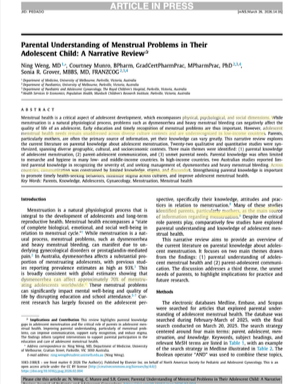
Parental Gaps in Knowledge
‘They (conversations) are often described as one-sided, with others leading the discussion and daughters expected to listen’ (Cite)
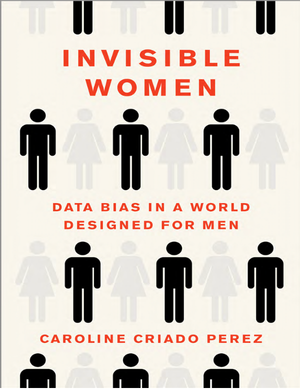
Women’s needs are systematically overlooked
‘Our current approach to product design is disadvantaging women’ (Perez, 2019).
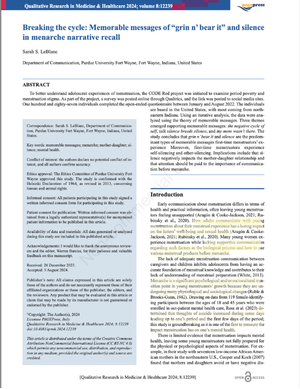
Silence is a key response to menstruation
‘It felt very shameful, and I was told it must be kept a secret from the males in my life’ (LeBlanc, 2024).
-
If the overall societal system is failing women (Criado Perez, 2019), and that system is making them feel shameful about a naturally occurring bodily function. Then societal systems are leading us to silence and a lack of knowledge in the area (LeBlanc, 2024). This leads to a generational knowledge gap about menstruation as parents are only stating what they know leaving no room for questions (Weng, Munro and Grover, 2026), which feeds into the system (Criado Perez, 2019), that caused the problem.
How can I challenge the systemic issue causing this knowledge gap?
Research
Menstruation Communication Survey
To better understand how I can design for societal change, I conducted an anonymous survey from July 15th to July 18th 2026. Posters with a QR code were placed around UAL LCC, resulting in six responses. The survey was anonymous to protect participants’ privacy and encourage honest responses.
“I was never explained how to use a pad or tampon, so having a crash course on that would have been great”
“ In a few years, you would start to bleed once every month, and your boobs would probably get bigger. You may also have some acne.”
-
While this survey was small, I received many great responses about what these women were taught and were not taught. I gained a better understanding of how supported people felt by their parents and how comfortable they were talking to them about menstruation.
This survey could have definitely been more detailed; asking about their age could have led to seeing a pattern in what generations knew versus what others failed to know. Looking back, I see that many of my questions felt surface-level, therefore leading to many surface-level responses. Going forward, I want my surveys to feel more thought-out and create questions that not only get great answers but make these women feel safe to share their stories.
Analysis
Secondary and Primary Research Analysis
After the research phase, I started to analyze my key findings from each reading and survey responses by using the Affinity mapping method. I grouped them with other insights that were related and created themes from the data.
-
After grouping these themes, I chose to focus on one that would help me answer my question, “How can I challenge the systemic issue causing this knowledge gap?” I chose to focus on Unmet Menstrual Education Needs.”
Since this topic exploration only allowed me a week to research, analyze, and prototype, instead of solving the issue, I chose to do a physicalization of the problem.
Concept
An enlarged tampon that exposes the silence and gaps in menstrual education.
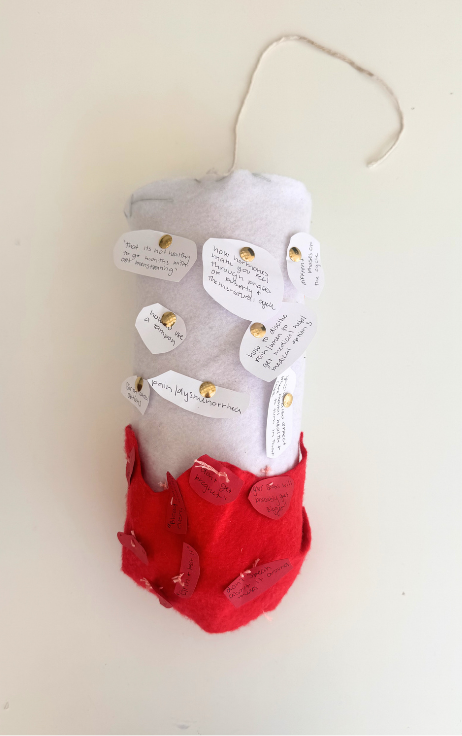
The tampon's large scale reflects the discomfort that often prevents discussion about menstrual health. The little red “blood” represents the limited information people are taught, while the large white space showcases the amount of knowledge they wish they had, exposing the educational gap created by silence and stigma.
-
This prototype isn’t a final product but a way to showcase the gaps in menstrual education for parents and children. This mini topic exploration has prompted an interest to examine other areas of women's health where education and support are stigmatized.
References:
Weng, N., Munro, C. & Grover, S. (2026) Parental Understanding of Menstrual Problems in Their Adolescent Child: A Narrative Review. Journal of Pediatric and Adolescent Gynecology. In Press. doi: 10.1016/j.jpag.2026.02.004
Criado Perez, C. (2019) Invisible Women: Data Bias in a World Designed for Men. New York: Abrams Press. ISBN 9781419729072
LeBlanc, S.S. (2024) ‘Breaking the cycle: Memorable messages of “grin n’ bear it” and silence in menarche narrative recall’, Qualitative Research in Medicine & Healthcare, 8(2), p. 12239. doi: 10.4081/qrmh.2024.12239.
