Micro Unit Part One
Brief: Design a way for textile waste to reveal its hidden value.
Team Members: Luis Winkelbrandt, Nicole Shu, Molly Wensley, Amen Maheen, Vanashree Chowdhury, Niki Marathia, Jaime Santos Guerrero, and Lynn Zhong
The challenge of designing a way to showcase the “hidden value” of a discarded textile is one that we did not fully understand at the beginning. We wanted to ensure the team was aligned on the brief’s goal before we began our research.
Accelerated video of our team breaking down the brief. We pointed out terms we needed to understand beyond the surface. Terms like “material histories” were interesting, as we know many of these materials have a ‘past life’, yet something seems hidden from us. Is there a way we can give the material histories a “platform”?
While finding terms to focus on was a major part of this experience, we ended up with so many questions. ‘What is the textile's purpose?’ ‘What is a moment of interaction for textiles?’ ‘What does an interface in this context look like?’
Reflection of Activity
Overall, this activity helped us collectively understand the brief rather than relying on individual and separate understandings, which, from experience, can lead to miscommunication and misaligned project goals. Since we are working in collaboration with FibreLab, we want to make sure we had a clear vision before meeting with them.
Areas to Explore
We were given three areas to choose from: Fashion Textiles Waste, Hospitality Textiles Waste, and Entertainment Textiles Waste. My mind immediately went to fashion. It is an area I am interested in working in the future, and also have the most knowledge about.
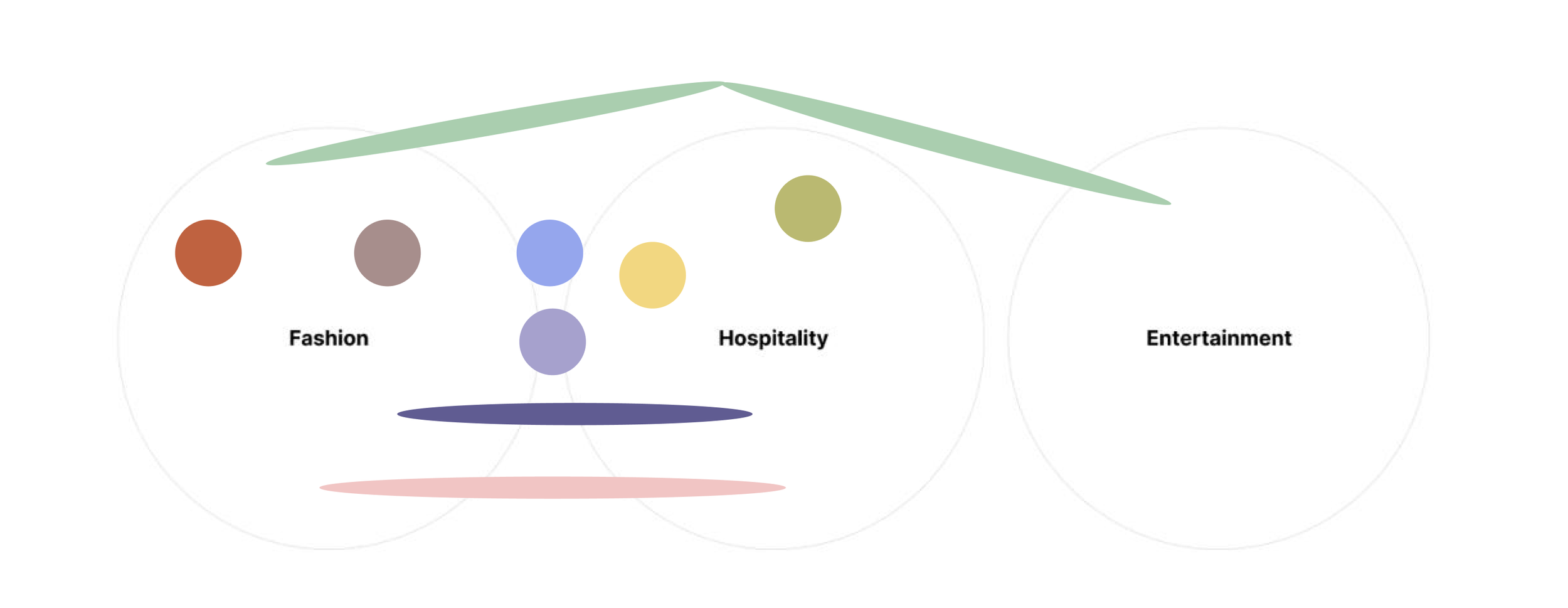
This initial activity was not based on research. Instead, it was solely based on first instinct. Originally, all the dots (in which each color represented a team member) were in one of the three areas, but once we started to discuss in a group, the dots started to stretch and shift (Activity created by Marathia, 2026).
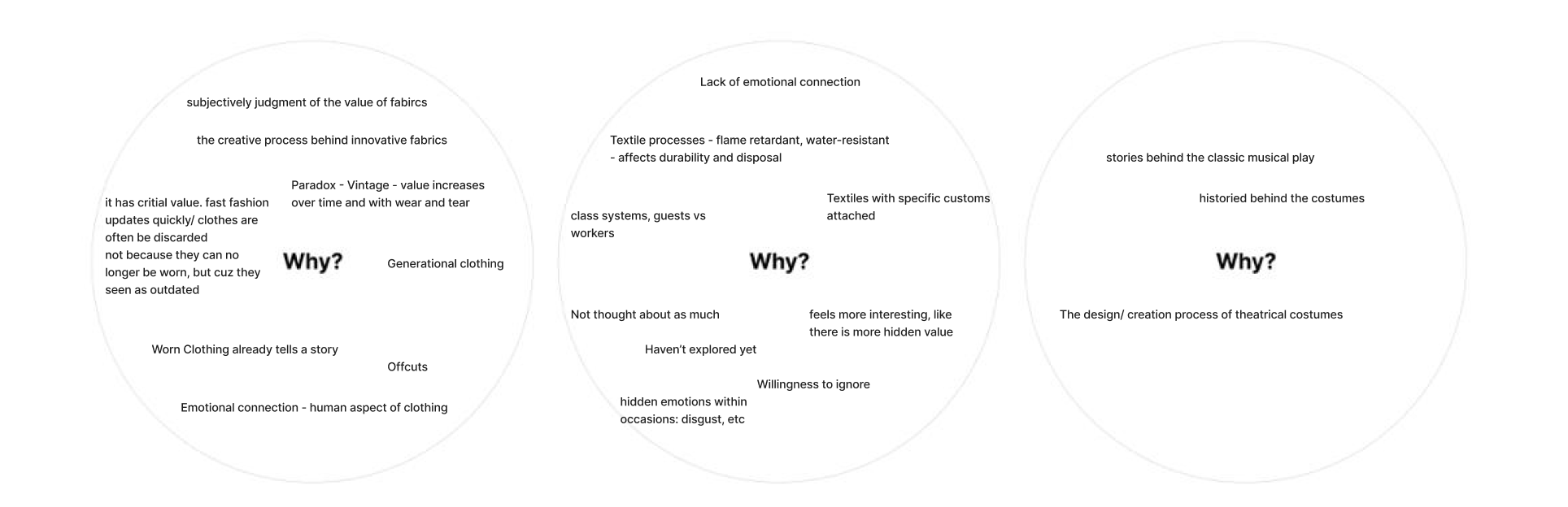
While we were discussing, we were also keeping track of why each team member felt the way they did. This is when my perspective started to shift. The points brought up about hospitality truly felt hidden: ‘Class systems, guests vs workers,’ ‘hidden emotions within occasions: disgust, etc,’ and ‘Lack of emotional connection.’
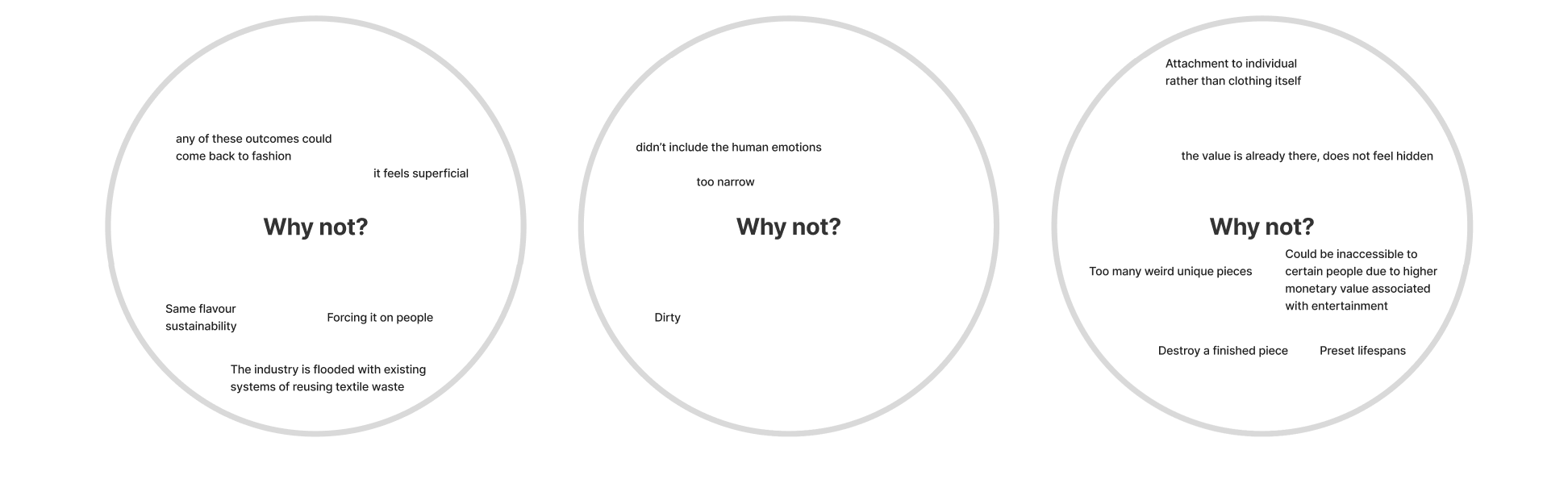
After this, we explored the ‘why not’ for each area. While there were valid arguments against them all, I found that “dirty” being placed in the negative column did not necessarily belong with the other ‘why nots.’
Reflection of activity
This activity led many of my team members to rethink their initial instinct. I was, at this point, leaning more towards hospitality. As mentioned above, the word “dirty” is placed in the “why not” area in the context of hostility, which made me want to find more. One of my most successful projects in this program is “Text Toilet,” which was built based on a quote from Mary Douglas (1966). This idea seemed like a logical continuation of that concept.
“Dirt is just matter out of place.”
Literature and Practice Review
We started our research process by reviewing the secondary sources that our brief provided, along with several sources we had come across. I was tasked with reading Zero Waste Approach in Sustainable Fashion Design: Designer Perspective for Pre-Consumer Waste Management (2024). The main takeaway from this article was that most of the environmental impact can be determined at the design stage.
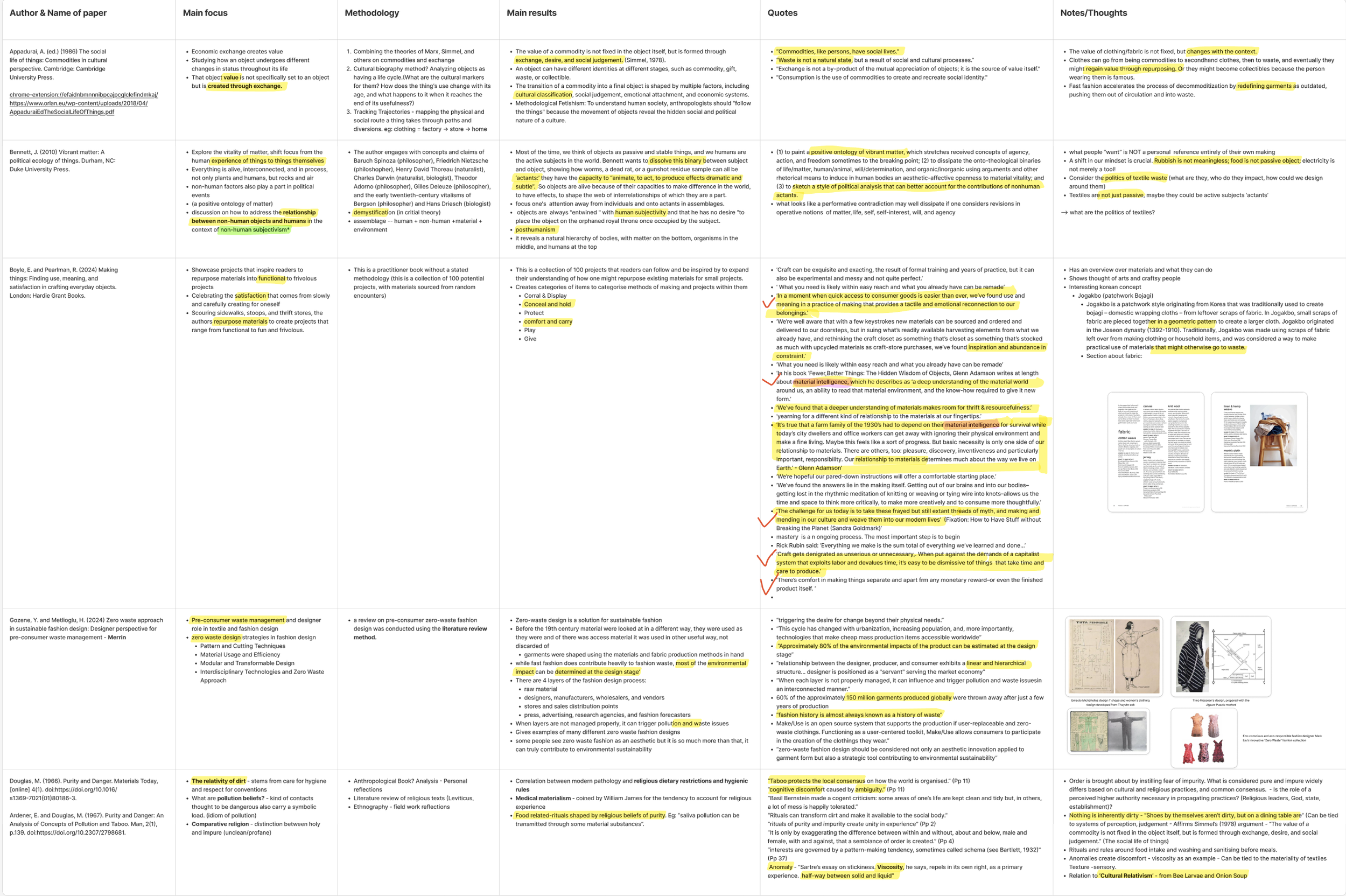
Initial literature review table. This table had categories for “Author & Name of paper,” “Main focus,” “Methodology,” “Main results,” and Quotes Notes/Thoughts. The highlighted parts were taken and added to the data notes you see below.
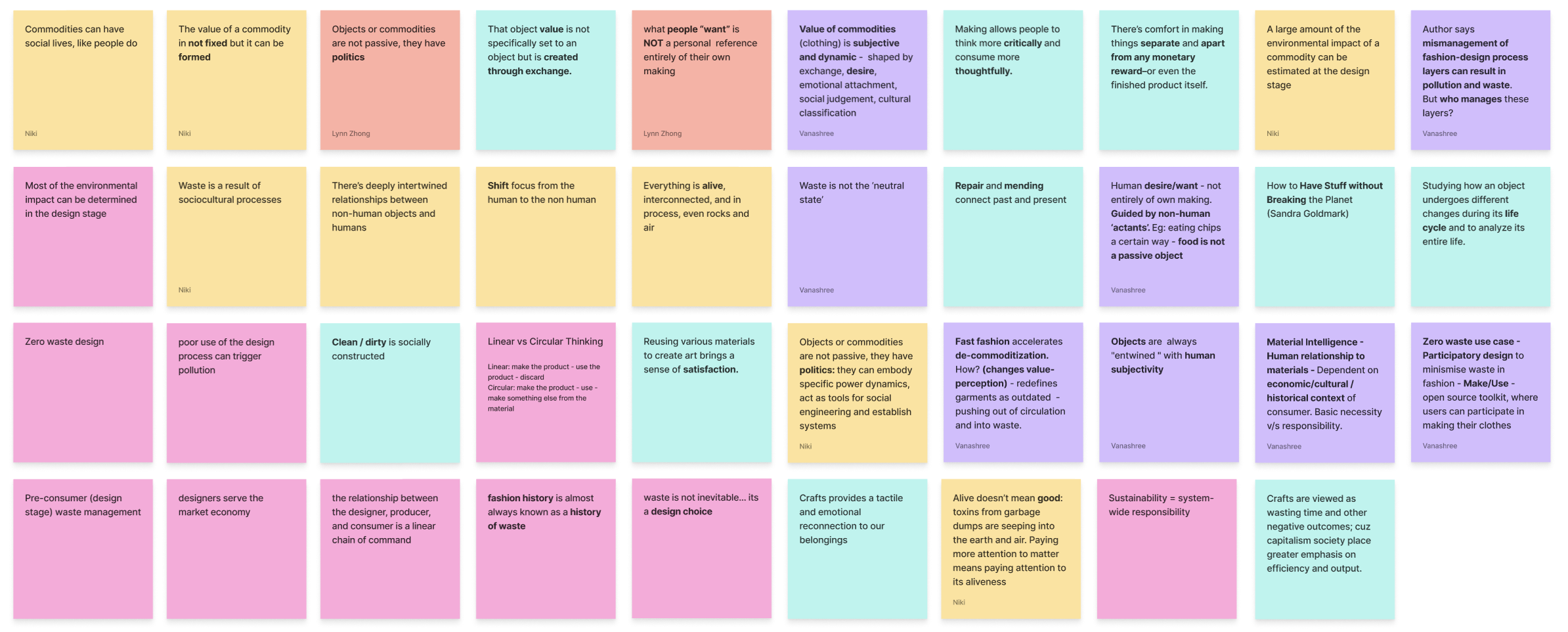
We then moved on to our data, which we took from the large table of research. These sticky notes contain data that we determined would apply to the brief and could help us further our research. We received feedback that it is necessary to write the source on each note, something we had failed to do.
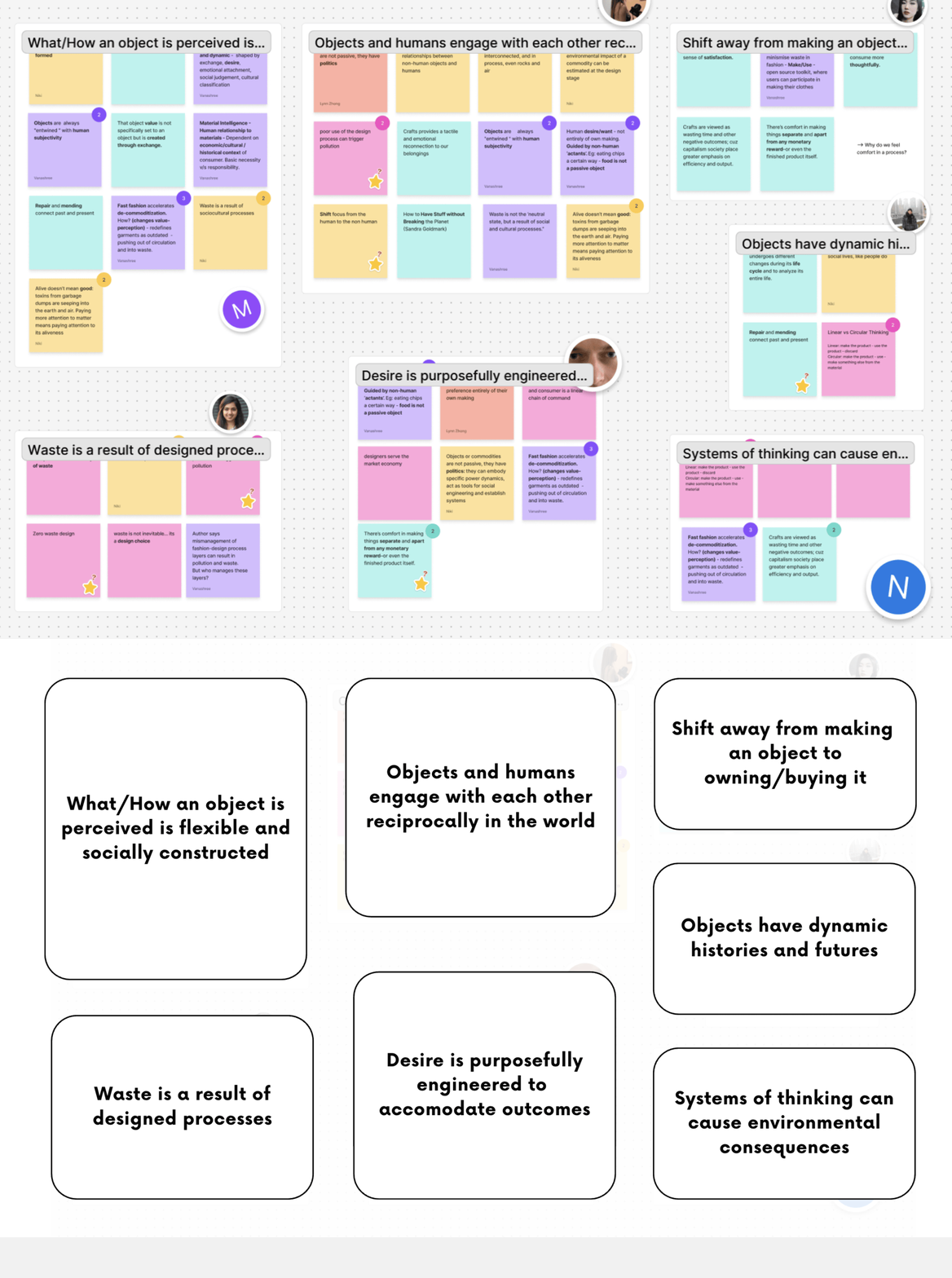
We then used the Affinity Diagramming method to create 7 themes from our literature review data.
We used the themes to conduct our practice review. We each chose a theme and then found one or two art and design pieces that relate. The theme I chose was “Objects have dynamic histories and futures.”
The first piece of design work that I discovered was the Sea Chair, created by Azusa Murakami and Alexander Groves. This chair was created out of ocean plastic waste. It was melted and made onbored a the ship they collected it on. This object encompasses the history of waste but also gives the past new meaning. The artist did not just use the final product to make a statement; they used the process as well. My main takeaway in relation to our brief was that the process of the interaction is just as, if not more, important than the final product (Studio Swine 2013).
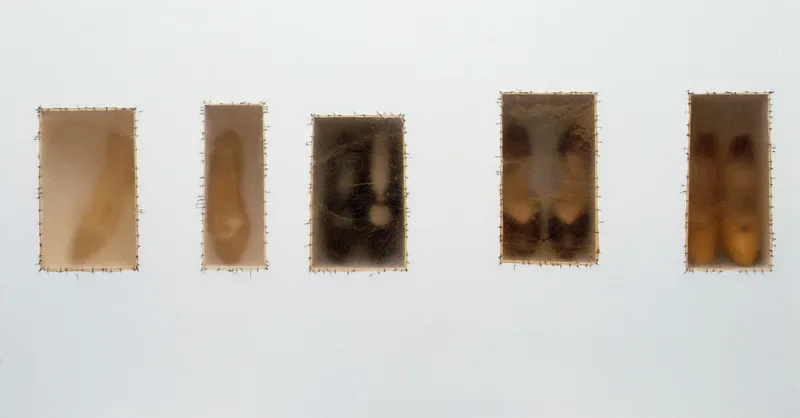
The other piece I came across was Doris Salcedo’s Atrabiliarios (1993). This piece was made from worn shoes that belonged to women who disappeared during political violence. The shoes are placed inside the wall. The main idea of this work is that everyday objects can act as personal memorials and storytellers. This made me think about how every textile has a story behind it, some with long lives and many short-lived.
Reflection of activity
I found that the literature/practice review helped us gain a better understanding of the research and the type of work that already exists. I believe we were able to synthesize our research to a certain extent, but I think we could have analyzed further how each of our takeaways relates to our brief, even seeing what industry it would fall under.
This Week's Reading
Audre Lorde's (2018) “The Master's Tools Will Never Dismantle the Master's House” explains that patriarchal systems choose whose knowledge and perceptions are valued. Our brief asks us to examine a system that is labeled as waste and to give it value. While this is not meant to be a direct comparison, both the reading and the brief showcase that systems decide what matters. We are hoping to challenge systemic power in this project.
References
Douglas M., . (1991). Purity and danger. London: Routledge.
Lorde, A. (2018) The master's tools will never dismantle the master's house. London: Penguin.
Gozene, Y. and Metlioglu, H. (2024) Zero waste approach in sustainable fashion design: Designer perspective for pre-consumer waste management
Studio Swine (2013) Sea Chair [Online video].
Salcedo, D. (1993) Atrabiliarios [Mixed media: shoes, animal fiber, and thread]. Guggenheim Museum, New York.
