UX of Radio Waves
BRIEF: Design an embodied experience of radio waves.
Group members: Eric Zhang, Diya Naik, Nicole Shu, Eniola Aminu, and Eryue Wan
Radiowaves and the electromagnetic spectrum are both concepts that I felt uncomfortable exploring, as they both connect to scientific elements. As someone who thrives in visual learning, this invisible infrastructure was difficult to connect to design. I knew that radio waves are pretty much all around us all the time, but as we researched, I realized that radio waves shape our culture, how we contact people, how we work, how we listen to music, etc. I began this project with a rudimentary high school-level understanding of radio waves. Through this research, I started to grasp the concept, not fully, but to the point where I could recognize where radio waves came from.
As a group, we decided we wanted as much information as possible, so when conducting our AEIOU research, we all chose different locations around London. Our locations consisted of McDonald's, Pret, the gym, the tube, outside of Canary Wharf station, and a Tesco grocery store.
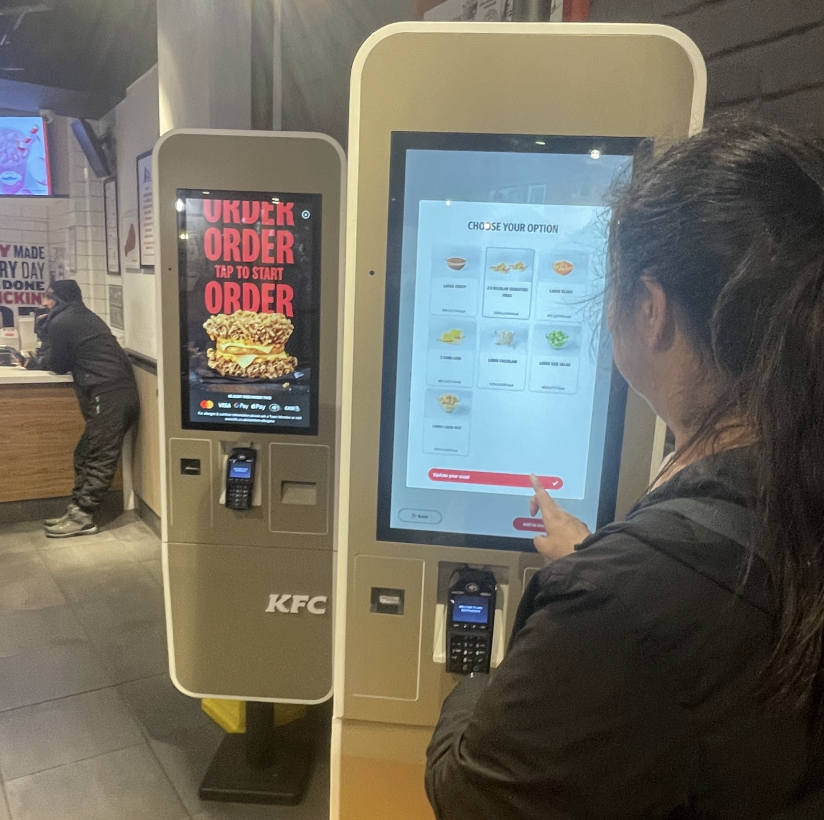
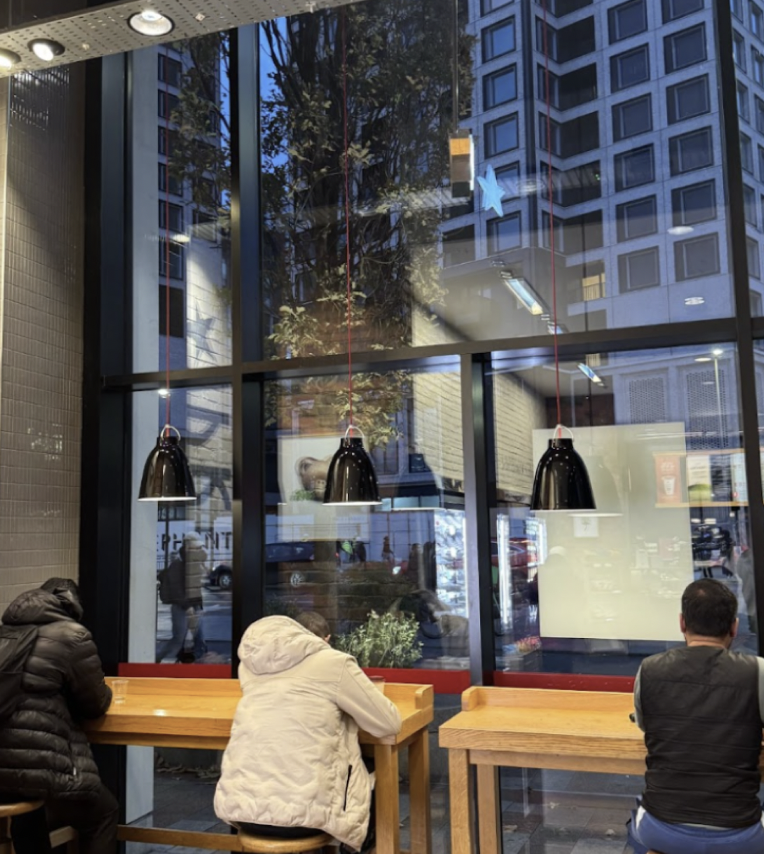
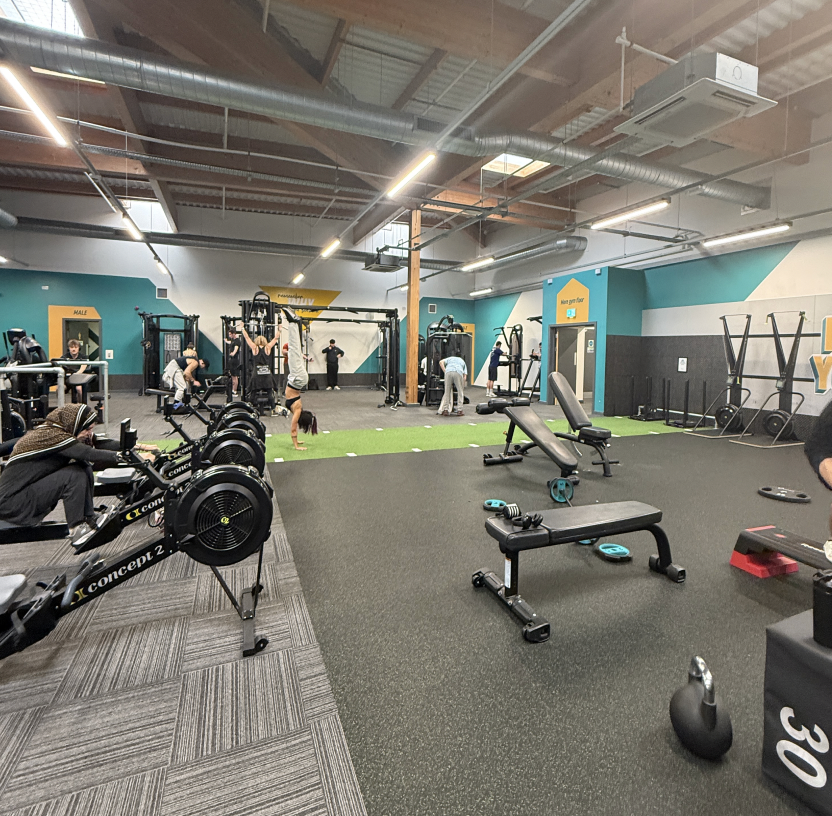
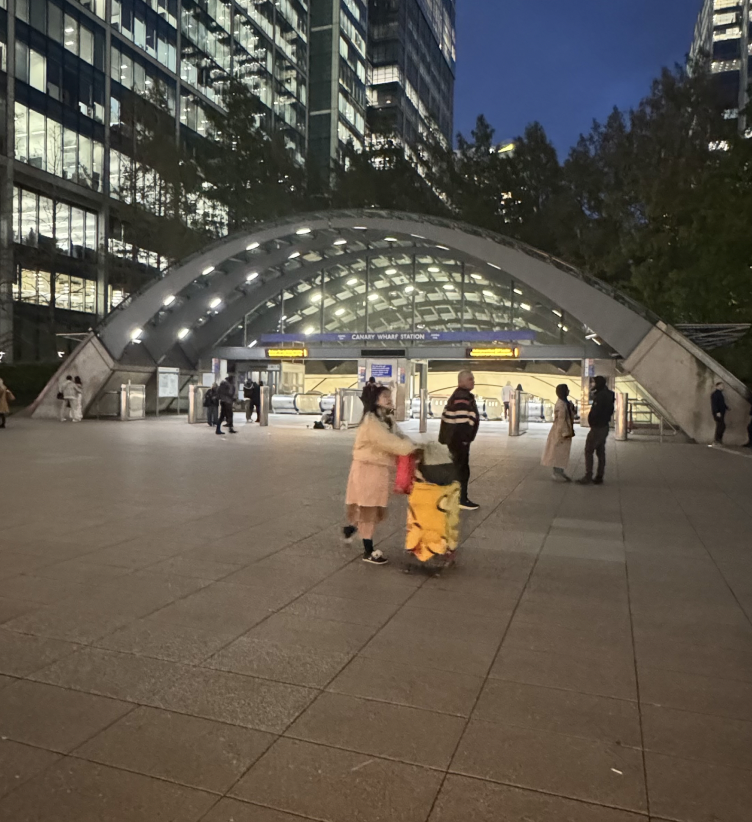
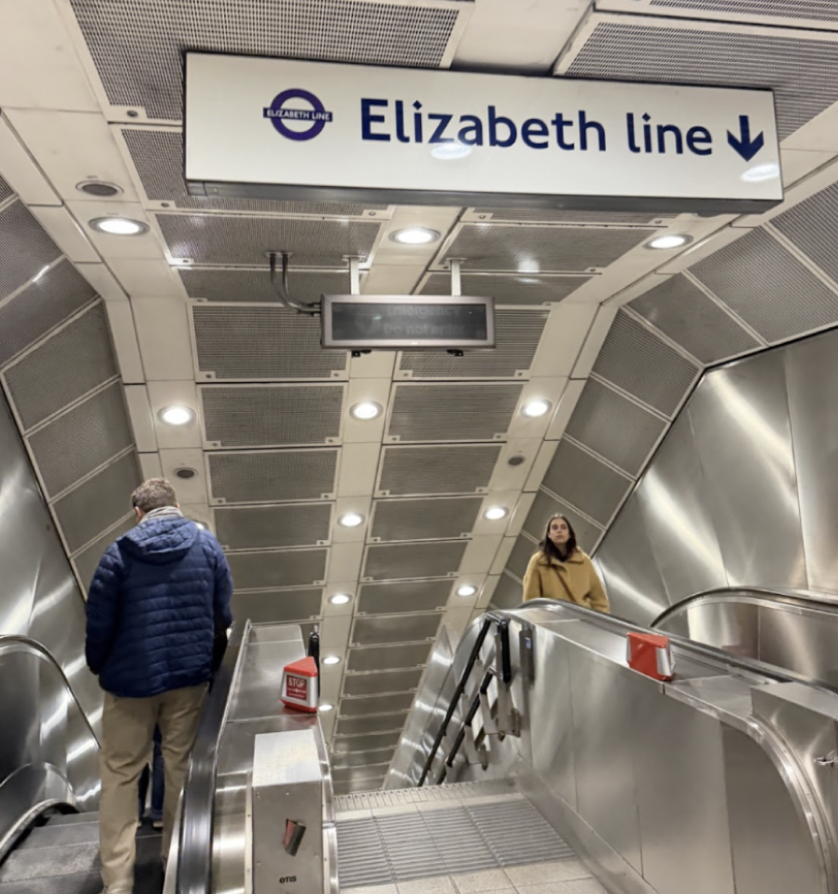
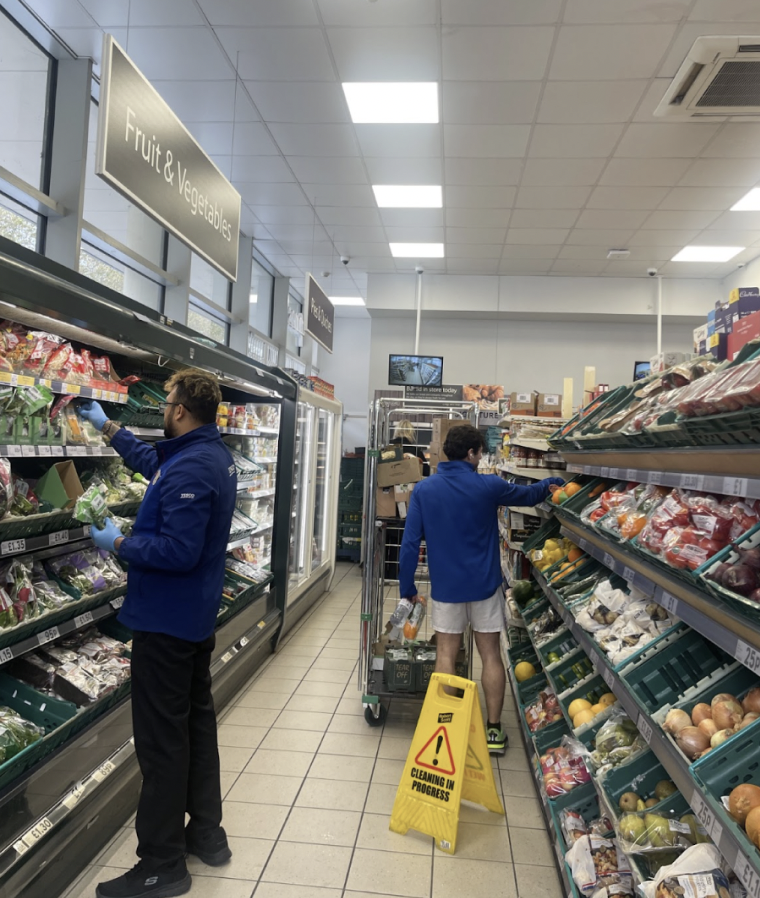
(Zhang, 2025), (Naik, 2025), (Shu, 2025), (Aminu, 2025), (Wan, 2025), and (O’Connor, 2025).
I conducted my AEIOU research just outside the Canary Wharf station around 17.00, when people were leaving work. The main thing I noticed was how much people relied on radio waves, especially in London. Things like phones, watches, headphones, Apple Pay underground scanners, computers in buildings, and the DLR all give off waves.
Canary Wharf during the daytime, showcasing the contrast of a radio wave surrounded area with natural elements to add balance to tall modern buildings (O’Connor, 2025).
Coming back together as a group, we discussed the Tube, as Nicole had spent a few hours observing behaviors when connection is not always available. She noticed that while people were not always digitally connected, they still were consumed by radio waves, especially with the number of people using wireless headphones to listen to music, podcasts, audiobooks, etc. This discussion led me to think back to Adam Greenfield’s (2017) Radical Technology: Design of Everyday Life, where he states that technology is ingrained into our daily rountines but many design decisions make technology feel invincible to the point where we stop acknowledging it as technology or never notice it at all. This helped me reframe the brief. It’s not about fully understanding the science behind radio waves. Instead, it’s about understanding how design decisions hide this invisible system in our everyday lives.
We asked for feedback on the topics of connection and isolation, especially with the information gathered on the Tube. Our feedback invited us to add directed storytelling to our research. We thought this would help us understand how people really feel about being isolated from the world and how people use radio waves as a shield to protect themselves from the outside world.
Going into the presentation week, we discussed the directed storytelling that we each conducted.
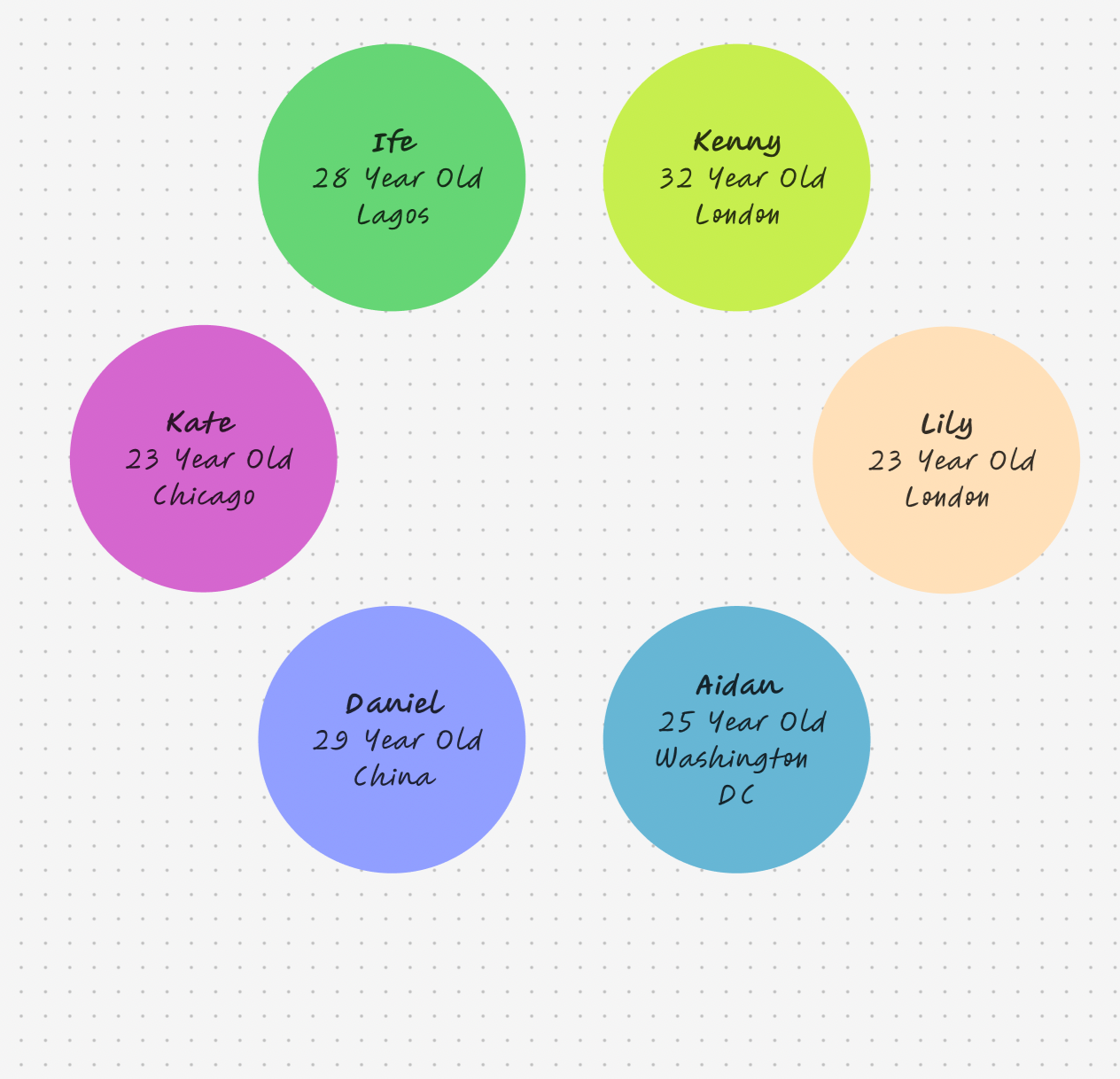
Using different demographics, we took information about how these individuals use devices to create a safe space for themselves. They used devices such as phones, headphones, etc. to block out unwanted noise, create a sense of privacy and control in public spaces, and enter a personal “bubble” where they feel comfortable and unseen (Aminu, 2025).
Next, we were able to use this directed storytelling to create a research question for a creative tool kit.
”Create what it feels like to be in your own bubble when you put headphones on.” Looking back, this question was quite leading, and we used “bubble” in a metaphorical sense, which made our brainstorming process more difficult than it needed to be.
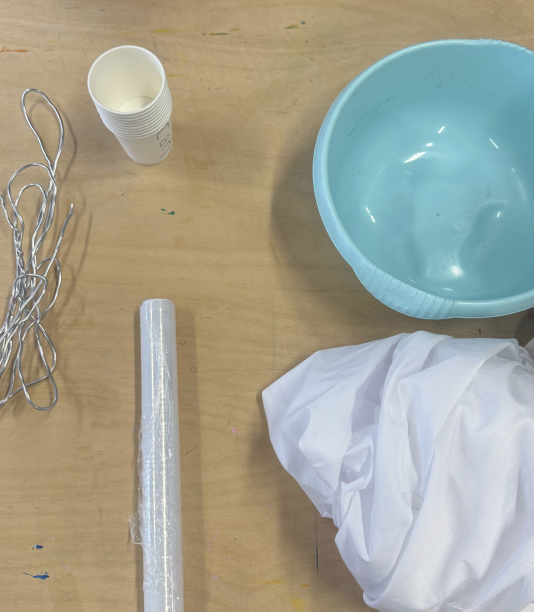
5 Objects
We decided to use only 5 objects to see what common themes arose, and what creations were made. A large bowl, a bed sheet, Saran Wrap, metal wire, and paper cups were the objects given for the test (O’Connor, 2025).
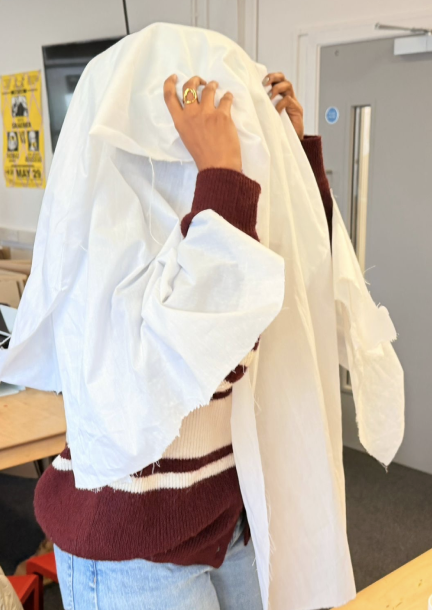
Completely covered - 2/5 participants
5 participants overall created two very similar designs. Pictured here is one of the ways people created their personal “bubble.” These participants wanted to fully cut themselves off from the real world (O’Connor, 2025).
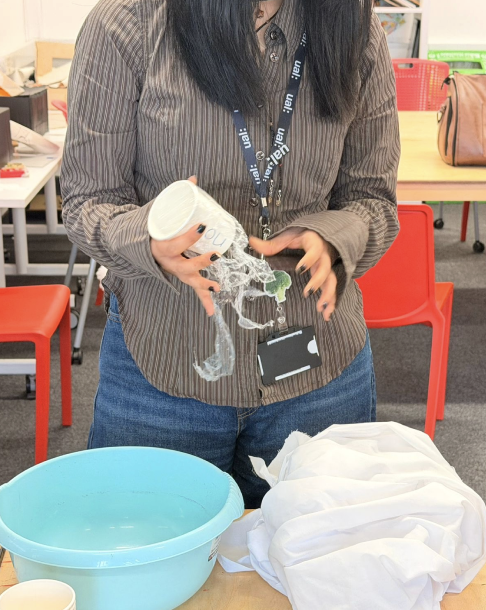
Small version with access to the world - 3/5 participants
The majority of our participants took the cups and wrapped them in Saran Wrap, and two used the wire to poke holes in the wrap. They all explained that they like keeping to themselves but feel the need to stay aware of their surroundings in public (O’Connor, 2025).
One of the participants who placed himself “inside” the cup explains why he chose the material for his “bubble” (O’Connor, 2025).
These insights help us when creating our idea, which was a tube simulation for people to ask for directions and help from other riders who are in their own “bubbles,” and highlight how absorbed people are in their devices (Lanette et al., 2018). This idea brought along some complications and would technically represent our idea of isolation, but would really just be a metaphorical performance based on devices, not radio waves, so we decided against this idea. Going into our final day, we had to brainstorm and connect our reach to a new idea.
We struggled as a group to agree on an idea, and we spent more time talking about what wouldn’t work in certain ideas and less time testing the ideas to see what could come from them. Going forward, I want to test ideas even if it is on a small scale or a body storming activity because it could bring about a whole new idea. Eric sketched an idea that we all felt was able to be turned into a concept.
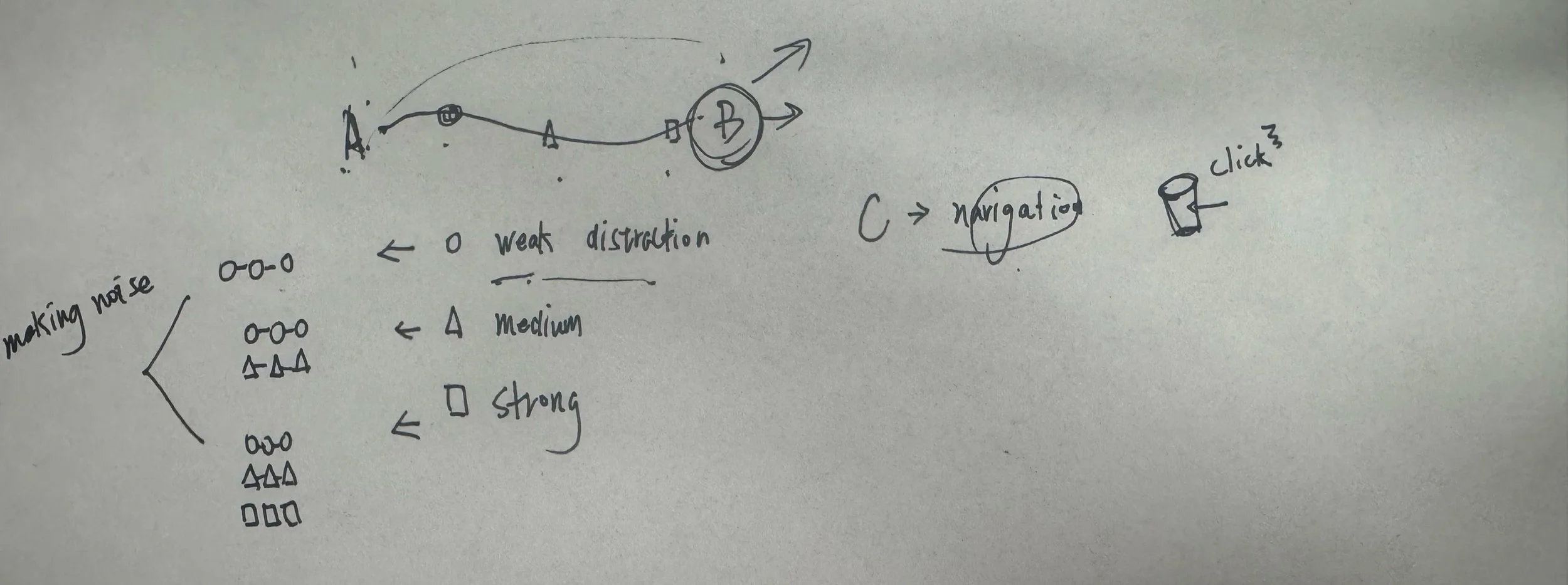
Original Sketch where the user would have to make it to the end without getting distracted by the “radiowaves” (which would be us trying to distract the user)(Zhang, 2025).
This sketch turned into our final presentation, where we gave a participant a role. They were obsessed with digital networks and radio waves, and needed to walk to point B to make it to the real world. We were all dressed as our apps, I played LinkedIn, and yelled notifications from those apps at the person while physically pulling them down. Showing how difficult it is to fully escape radio waves.
Our presentation was rushed, we struggled coordinating schedules, and most of our feedback consisted of us needing to focus more on radio waves and less on social media obsession. We were told that more research is not always better, which made sense. We had so many themes from our data that it was hard to realize what we actually wanted to present. I learned that it is important to dive deep into reach about one topic, not try to present them all.
References
Greenfield, A. (2017) Radical technologies: the design of everyday life. London: Verso.
Lanette, S., Chua, P.K., Hayes, G. and Mazmanian, M. (2018). How Much is ‘Too Much’?. Proceedings of the ACM on Human-Computer Interaction, 2(CSCW), pp.1–22. doi:https://doi.org/10.1145/3274370.
