UX of Whispering
BRIEF: Design an experience that amplifies the qualities/customs of whispering.
Group members: Jaime Santos, Xiyan Lou, Molly Wensley, Vanashree Chowdhury, and Yihan Zhong
This brief required us to look at whispering not only as a form of communication but as an experience that involves different cultures, places, sensory qualities, and universal understanding. Our group started with bodystorming tests as we wanted to see what the qualities of a whisper. These tests included a regular whisper, a blindfolded whisper, location whispers, a string telephone, a party scenario, “scream with no breath, an echo whisper, a telephone game, and a cup whisper.

The Regular whisper helps us set baseline expectations for the other activities (O’Connor, 2025).
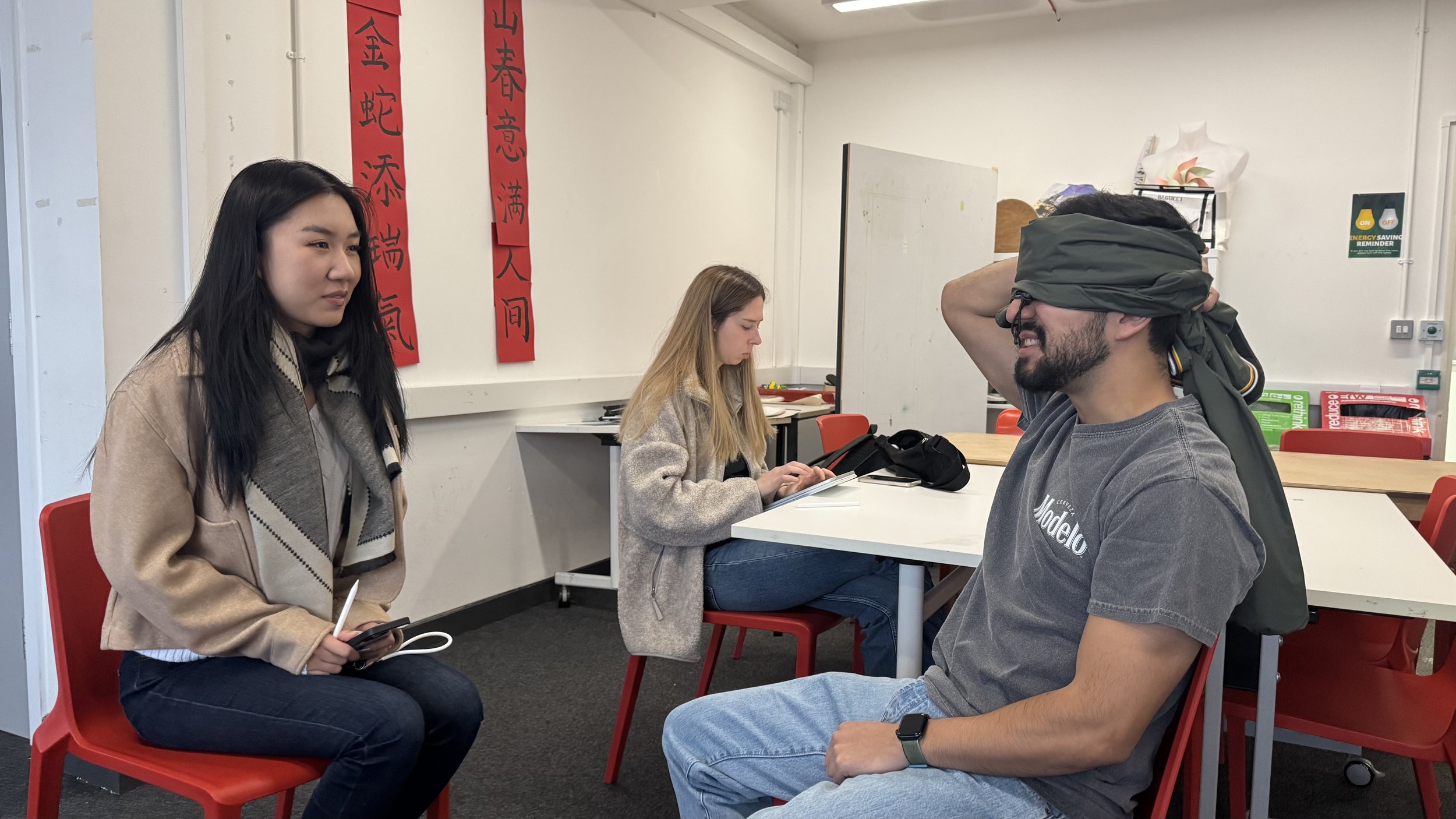
The Blindfolded whisper allows us to see how much the listener, who is blindfolded, could understand without seeing any lip movements, hand gestures, or body cues. He was able to hear some things, but taking away his sight made it much more difficult (O’Connor, 2025).
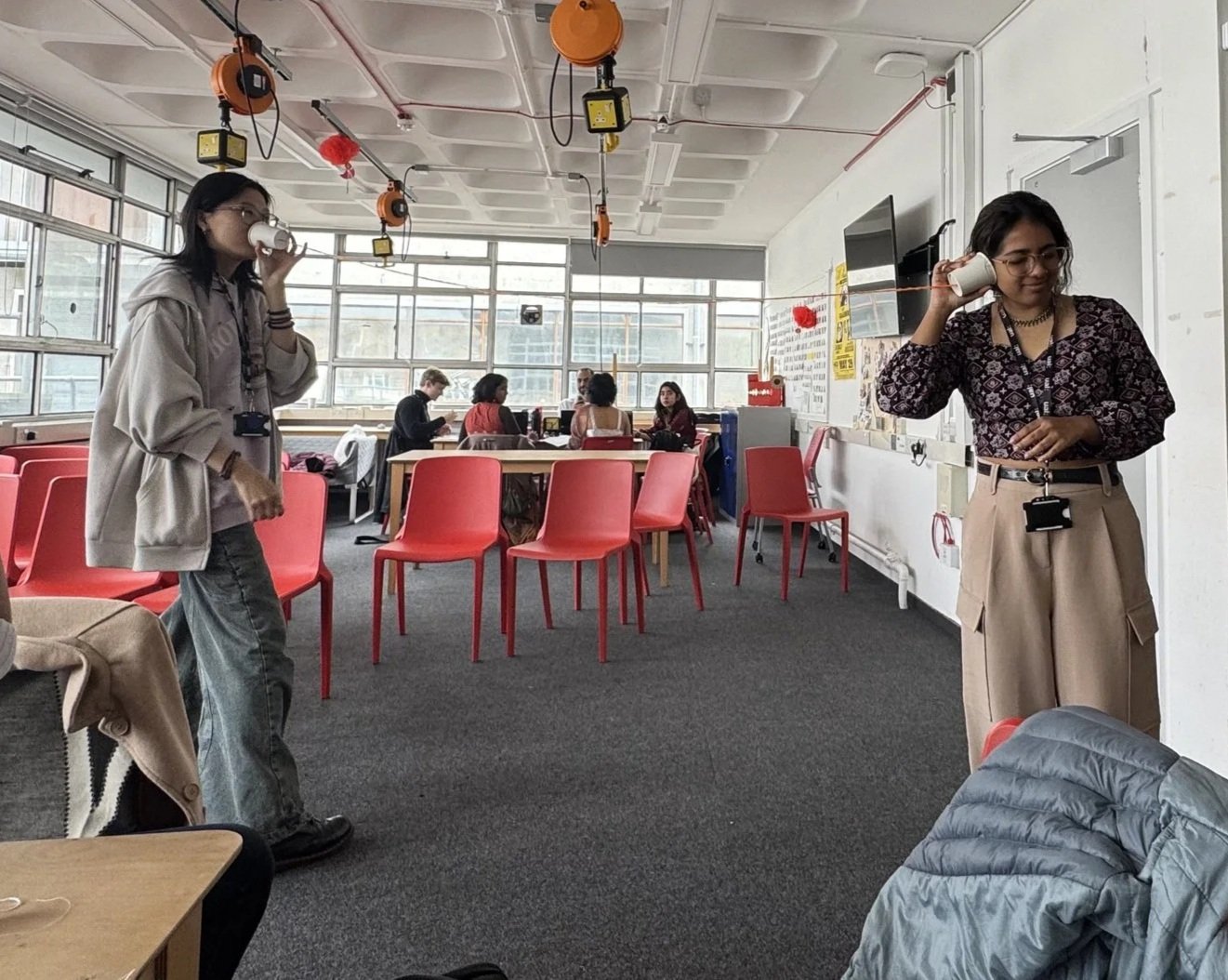
The string telephone helped us understand how physical material can be used to amplify a whisper. The cups did work, although the sound was heavily muffled (O’Connor, 2025).
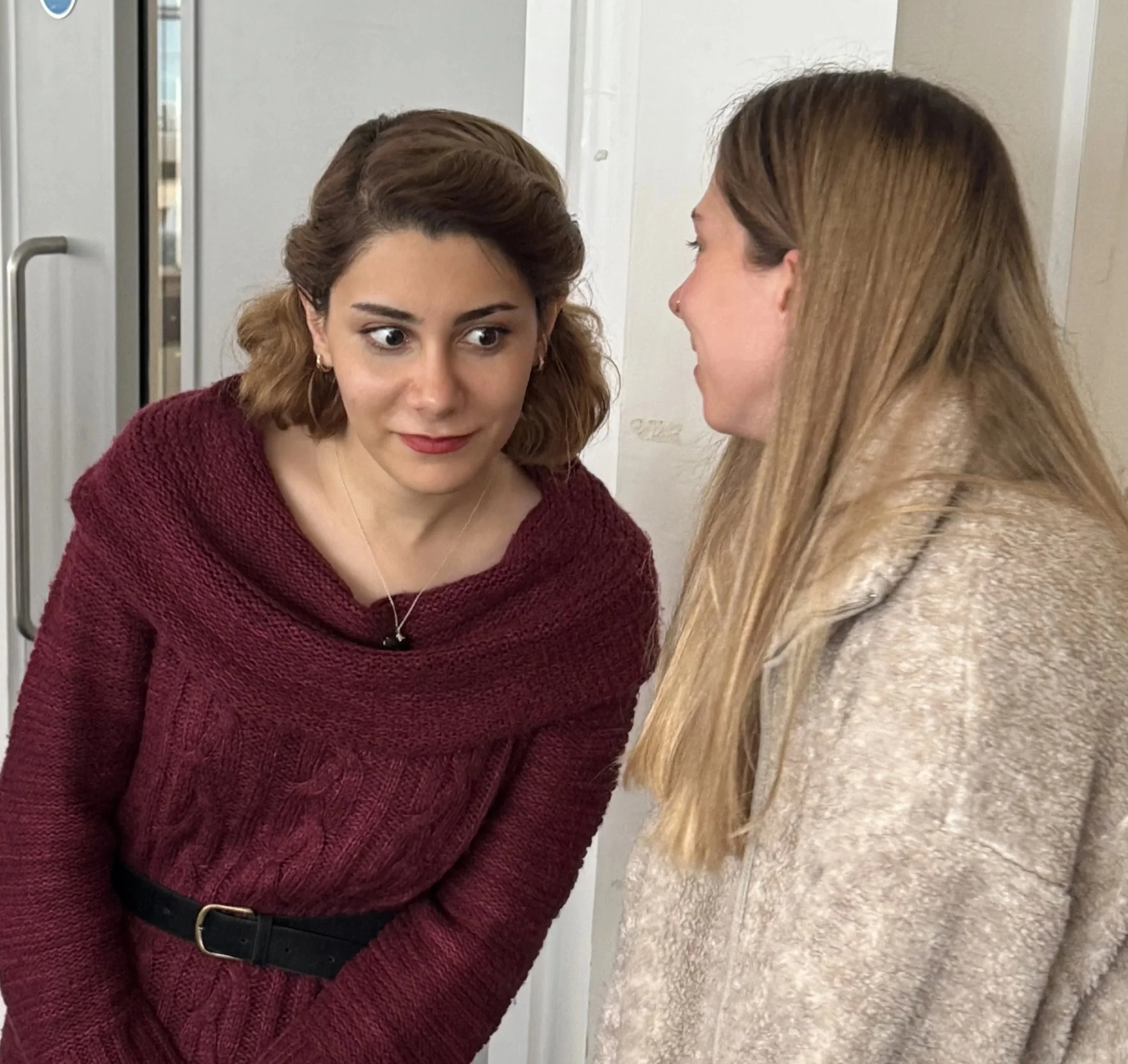
The “telephone game” gave us insight into how whispers can be misinterpreted when passed through a large group of people (O’Connor, 2025).
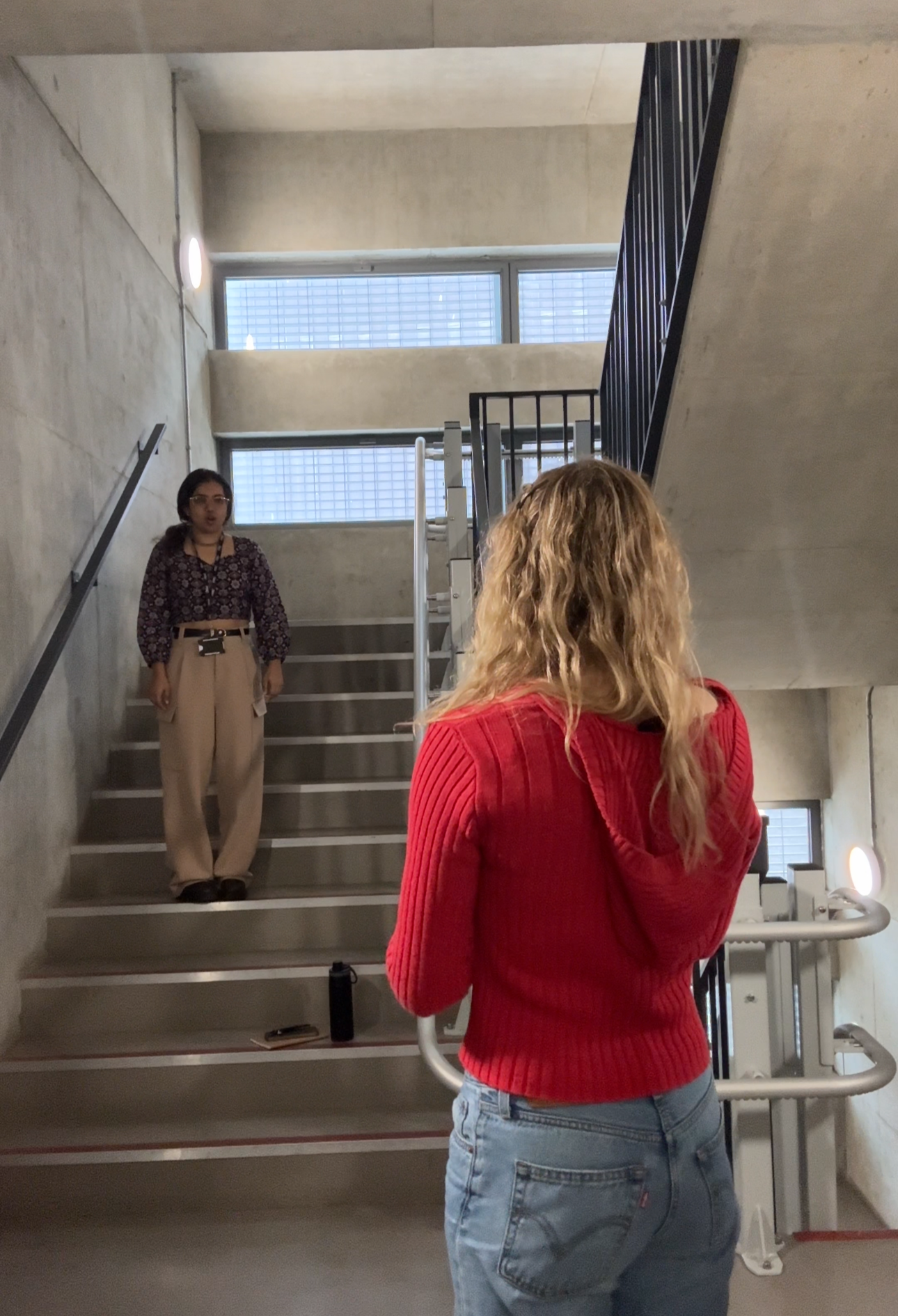
The last bodystorming activity was an echoed whisper. When a whisper is amplified by a reverberant stairwell, then the receiver can hear the whisper louder than it is being said (O’Connor, 2025).
Individually, we conducted our directed storytelling interviews, which, looking back, gave us the most insight into whispering. The opening question was “Tell me a story about a time you were in a place that had restrictions based on noise volume, and how you communicated.” The person I interviewed told me about the time they visited the Sistine Chapel in Rome. They described the environment as “hushed but alive.” She continued to say that most people relied on gestures and lip movements to communicate. The Sistine Chapel has strict rules to maintain a reverent space, and you are asked to be completely silent. The employees enforce this rule. She said, “What intrigued me most was that every few minutes, people would get louder and have to be silenced again, like a repeating cycle of the employees controlling the volume levels.” Just as Li (2011) explains in Whispering: the murmur of power in a lo‑fi world, whispering can be a form of power, where someone in control determines the volume. Which also brought up the question for me: who determines who is quiet and who is loud? Especially thinking about it politically at this point. Does censorship play a role in this power dynamic?
When we combined all of our interviews on a mindmap, there were 3 common themes: tension, control, and connection.
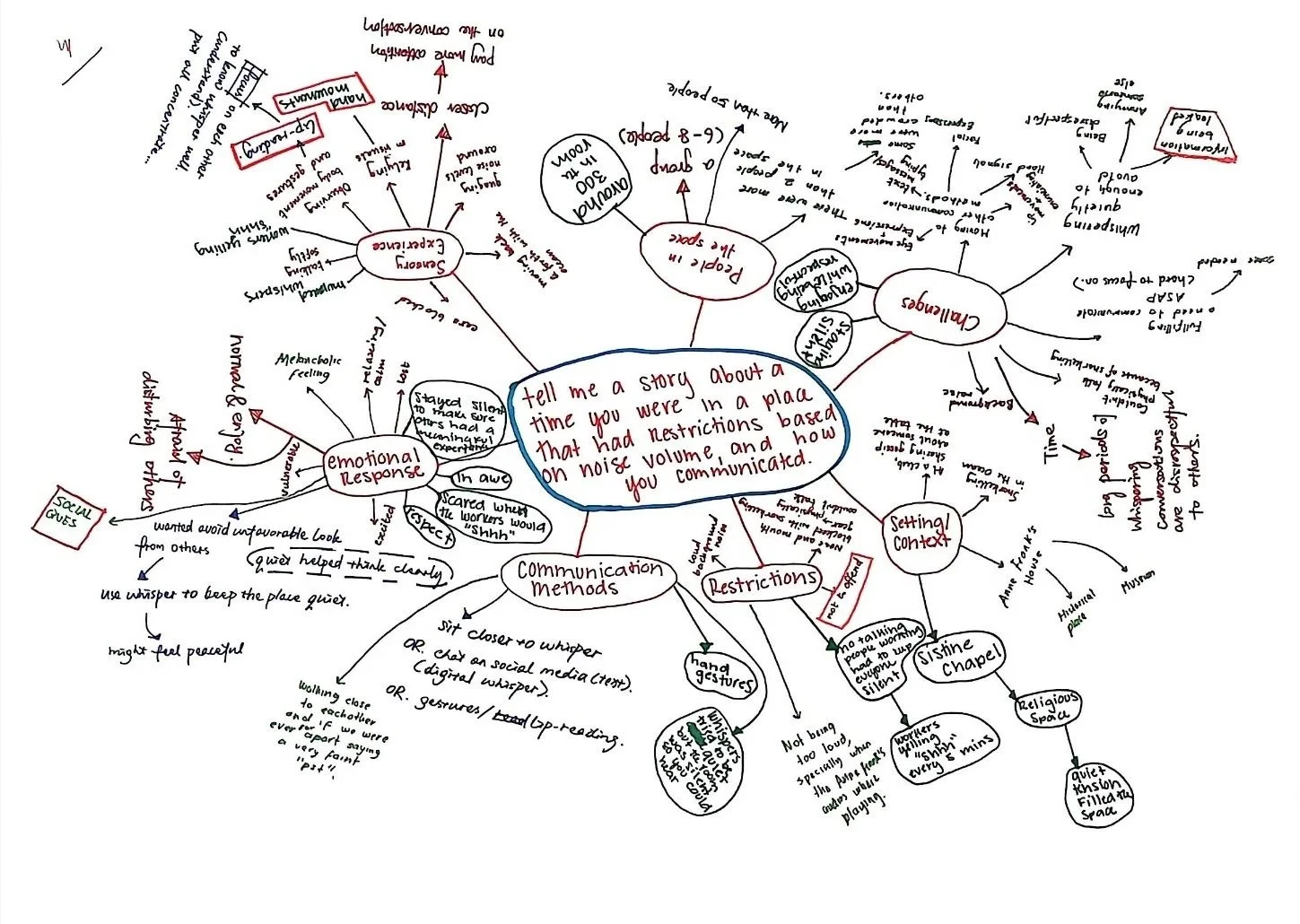
Map of our main takeaways from the Directed Story-telling interviews (O’Connor, 2025).
Many of us identified the control element in a whisper, which can be for religious purposes, for secretive purposes, and can also be used playfully. After much group discussion and feedback from tutors, we decided to move foward the idea of a Speaking Choir. While we did not have a concrete idea of what this might look like, we felt that if we could control the volume at which people talked through authority and universal gestures, then a whisper was bound to happen.
Going into the final week of our project, we felt confident in our idea, but Jaime brought up a new Idea and we decided to test it. This idea includes a digital live stream of someones lips. This would truly amplify the qualities of a whisper, especially if the lips were saying something secretive or holy.
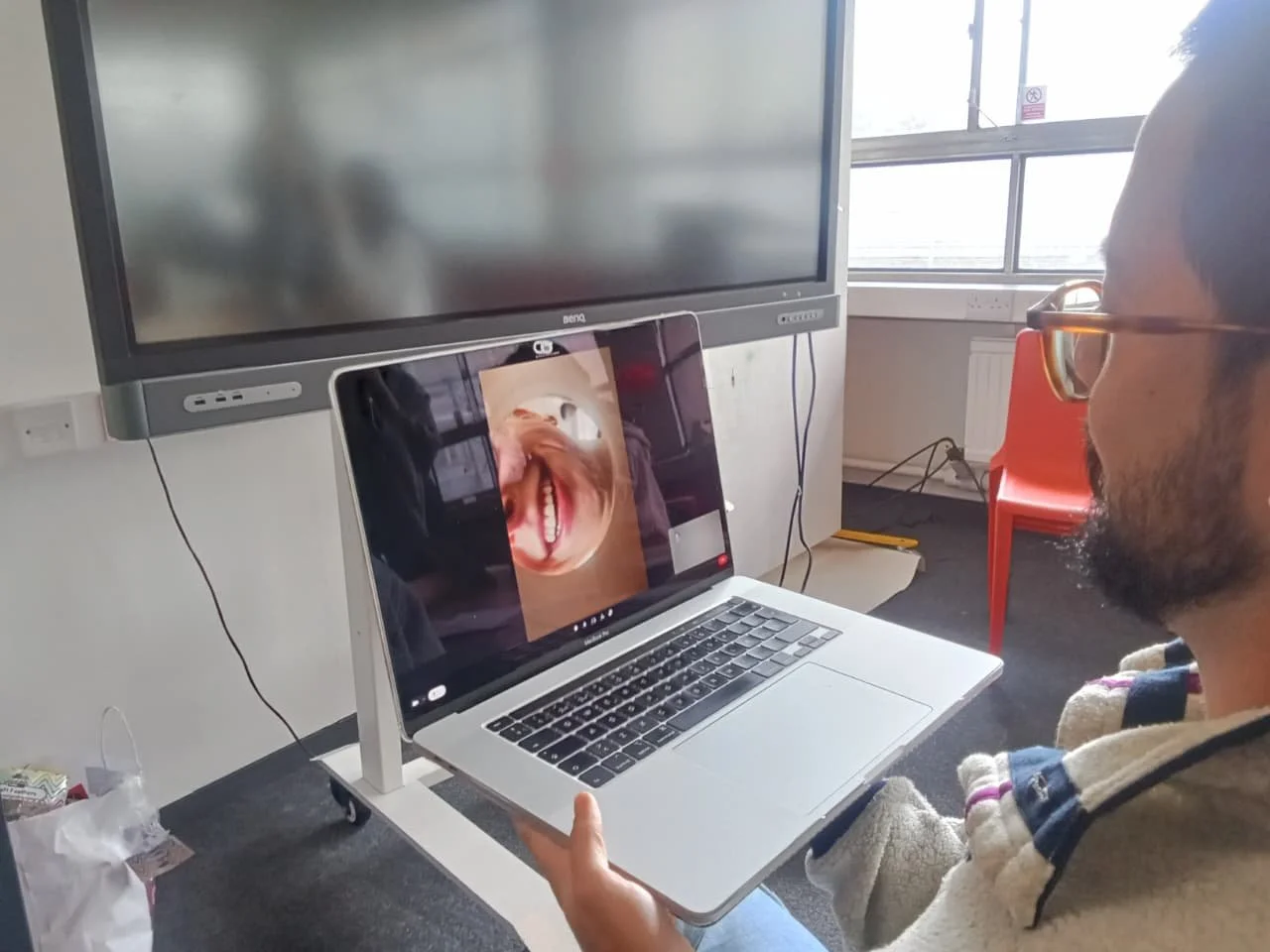
Small-scale test of amplification of a whisper. Using WhatsApp FaceTime, we are testing to see if the qualities could truly be amplified (Chowdhury, 2025).
We ultimately decided against this idea as we felt our research was better represented by the Speaking Choir. The rest of this week was focused on gesture research and user testing. We ask students what gestures they associate with whispering or being told to adjust their volume level, and we also brought in our own knowledge of gestures.
Gesture insights about what people associate with members of our group and also people outside our group (Chowdhury, 2025).
We then began testing our main idea. Each with different word participants are asked to say those words, but without telling them, our conductor (Vanashree) would use the data from of reaserch on universal gestures to control their volume. Through our secondary reserach we also found that a gesture can convey meaning, social significance, and authority (Clough et al., 2020). We made sure that Vanashree was able to establish authority with the choir through body language and a strict vocal cue at the beginning. While we discussed giving the choir some context, i.e., Vanashree would portray a political figure giving a voice to only certain people while ignoring others. We decided to keep the main focus on the gestures rather than taking a political stance, since none of our directed storytelling offered political insights
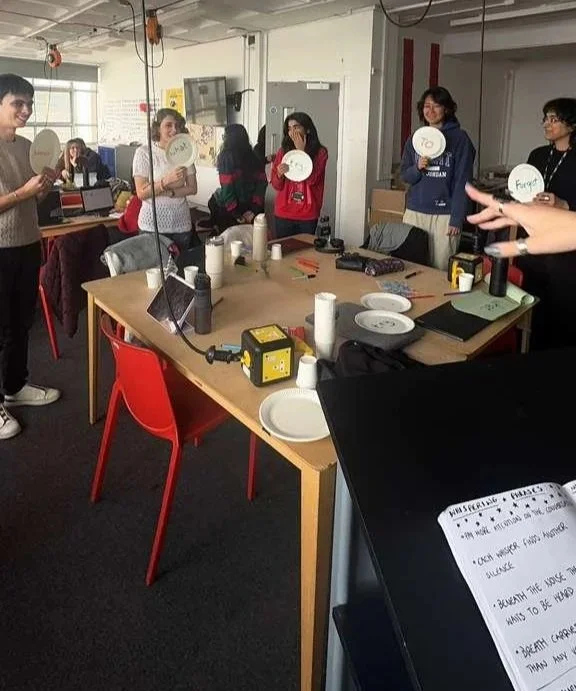
Coursemates testing the Speaking Choir. Their feedback gave us insights into how some participants could perceive a hand lowering as making one’s voice deeper rather than whispering. We changed the gestures and went on to test again (O’Connor, 2025).
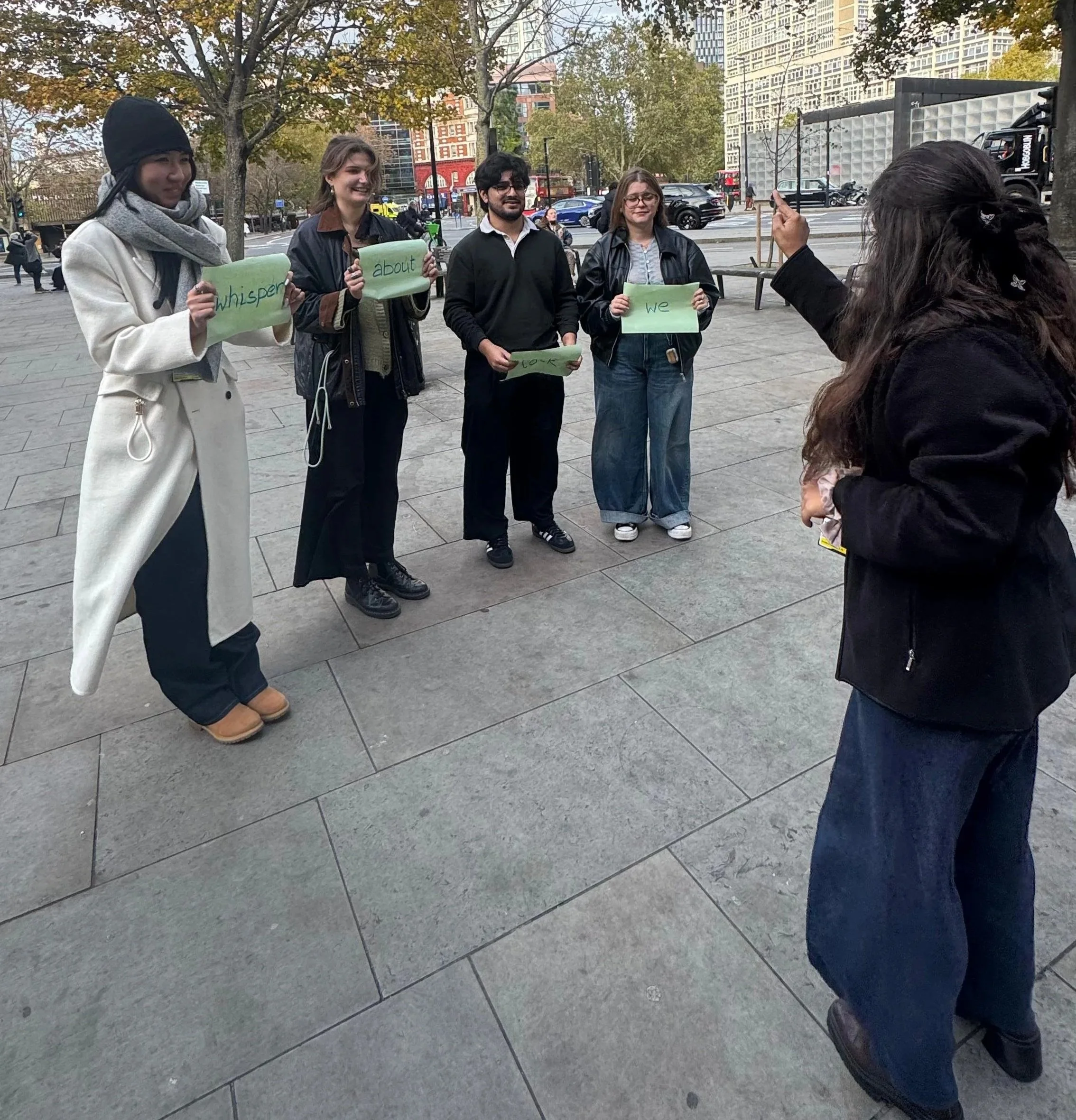
3 students, not in MA: UX, were able to grasp the concept without much explanation, and they knew what the gestures meant, confirming our research that the gestures we have chosen are understandable (O’Connor, 2025).
The gestures we tested and the ones we chose to use are based on user feedback and testing (Chowdhury, 2025).
During our presentation/performance, we had seven groups of two people. Although volunteers were not informed before starting that they would be responding to gestures, they followed along. This showcased our main idea, that power and universal gestures can get people to adjust noise volume.
Final Presentation of the Speaking Choir
I was honestly surprised by the feedback. While I liked our idea, I was hesitant about its performative nature and did not feel like it completely answered the brief. But after hearing the feedback and thinking further, our research and niche topic of gestures mixed with control held a convincing argument for its application to whispering. Vanashree committed to her role as the conductor and took her role very seriously, which I admire and hope to emulate that same commitment in future projects.
I believe that this project could be done on an even larger scale with 20-30 groups, to see how a conductor might act differently, or if they would not be seen as well as Vanashree was.
Refereneces
Clough, S. and Duff, M.C. (2020) ‘The role of gesture in communication and cognition: implications for understanding and treating neurogenic communication disorders’, Frontiers in Human Neuroscience, 14:323. doi:10.3389/fnhum.2020.00323.
Li, X. (2011) ‘Whispering: the murmur of power in a lo‑fi world’, Media, Culture & Society, 33(1), pp. 19–34. doi:10.1177/0163443710385498.
