UX of Digital Interfaces
BRIEF: Design a physical environment derived from a digital one
Group members: Yifei Huang, Sakshi Pansare, Luis Winkelbrandt, Susil Kumar, and Clara Chow
After the brief was announced, my group was very excited to get started. We discussed 3 different apps to choose from: Duolingo, Strava, and GrubHub. After a short discussion and a unanimous poll, Strava was the winner. Strava is an app where users can track and share exercise. Strava is known for its running platform that motivates users and creates communities through active lifestyles.
We started off using the Love Letter and Breakup Letter method. Where we explored the features we liked about the app and the ones that would stop us from using the app.
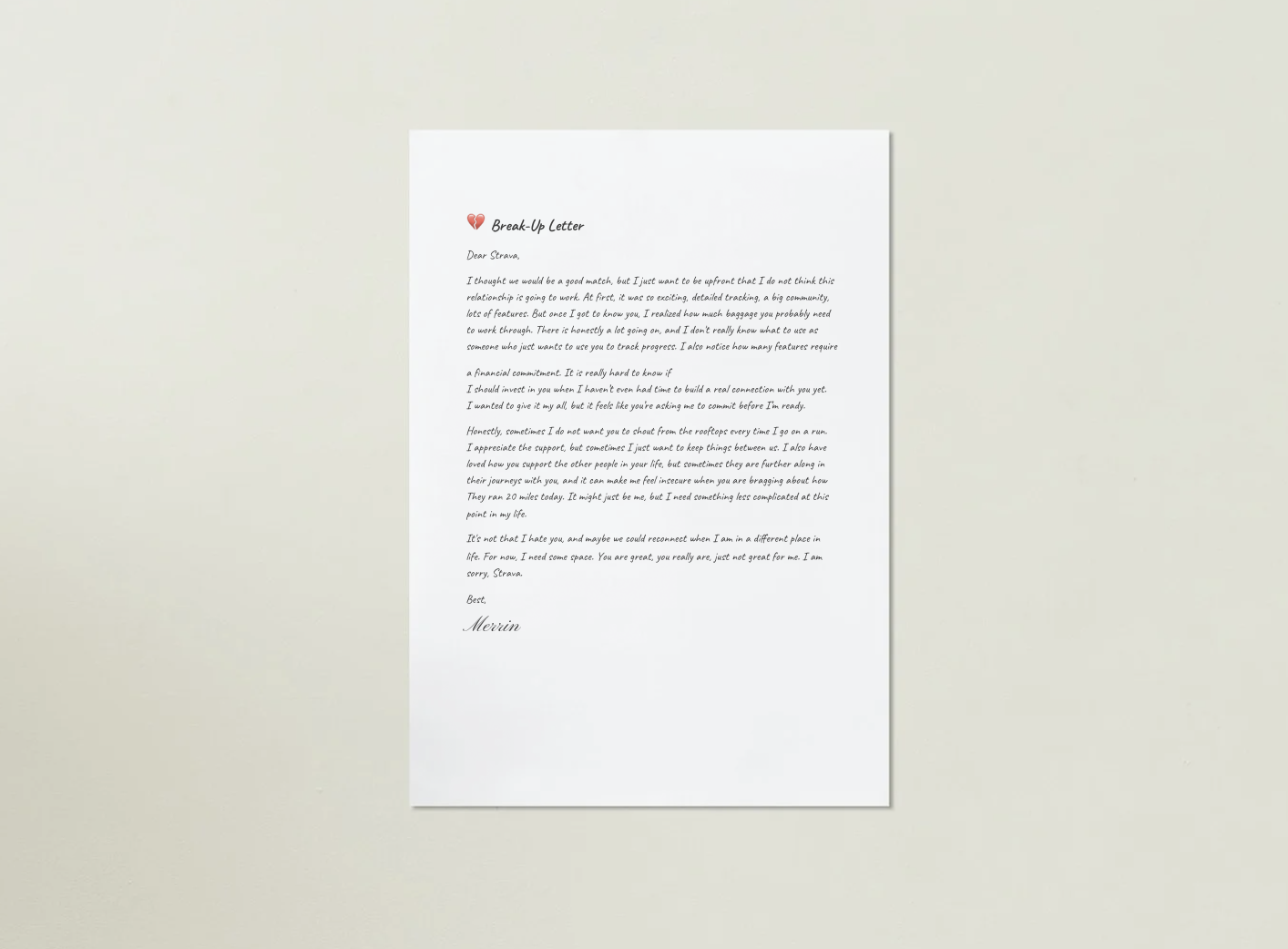

My letters share that I love the motivation and community it brings me, but I can't stand the constant comparison with others.
From writing my letters and looking deeper into an app that I have only used a few times, I found this app can be very motivating for people who have a hard time motivating themselves and need a rewards-based system, which is a perfect example of the Theory of Self-Determination (Ryan and Deci, 2012). However, it does feel like people post runs to brag, not to help motivate others. After that, we split up the sections of artifact analysis, and I took on the aesthetic elements and material culture. I went in wanting to know how these visual elements reinforce motivation and community. We also realized that with the material culture of Strava, it’s not just an app its more of a lifestyle with traditions and rituals.
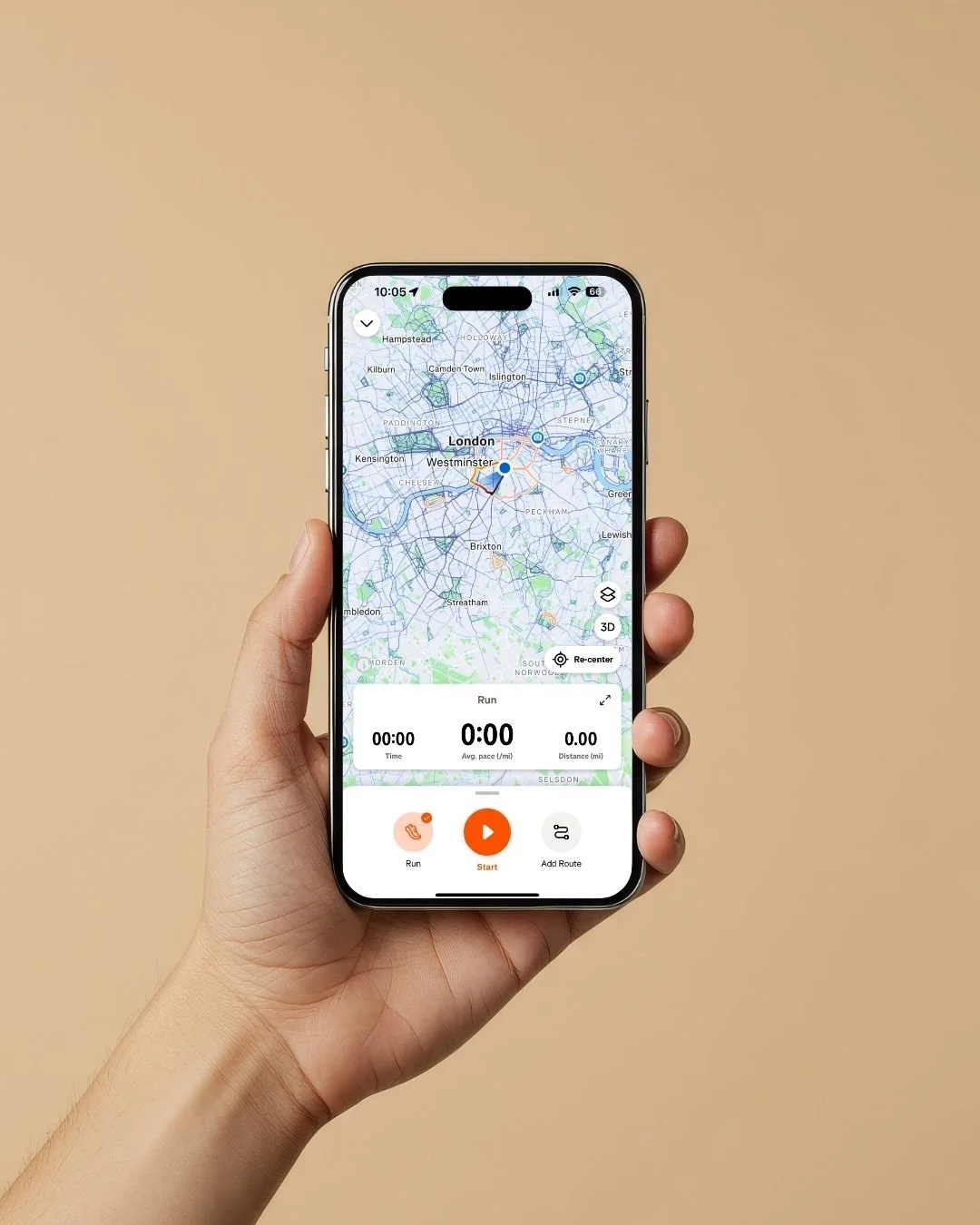


Screenshots of different features and graphic elements of Strava, its intense orange color portrays a sense of urgency for certain features, like starting and sharing a run. Each element plays a role in the routines and rituals that users practice.
Our first idea was to focus on the gamification of Strava and make a board game where you could change out the maps just like in the app. But the game felt surface-level, and it did not embody the negative aspects of the app that we found through our research. We wanted to be critical of Strava, as we had found many people risk their health and even their lives to meet goals or post impressive stats (News, 2012).
Taking a dark turn, we decided we wanted to portray Strava as a cult. The more we looked into the app, the more motivation seemed to turn into obsession and social comparison. By the end of the first week of this project, we decided we wanted to make a Welcome to Strava video where participants are invited to join Strava. We took inspiration from a Stand Hook promise ad (2012), which appeared happy in the beginning, but takes a dark turn in order to get a message across.
Just as Greenfield (2017) argues in Radical Technologies, people have a hard time recognizing when they want to pick up their phones and when they pick up their phones out of habit. This is the same with Strava’s system, and the user cannot see the difference when they want to exercise or when they want validation and rewards. As mentioned above, it is a ritual that users feel compelled to do. It’s a dangerous way for users to interact, which is why we wanted to be critical of it.
We decided that, instead of only a video, we should perform a Cult initiation with design elements and techniques that Strava uses to create these feelings of empowerment, but also comparison (Ryan, Edney, and Maher, 2019).

Prototype of the 2-tier initiation alter, featuring aspects of the running that Strava promotes. The top tier holds a water bottle, a pair of shoes, a headband, and an Apple Watch, while the lower tier has four cups for the initiates to drink out of. This alter is a layout of what will be used in the final presentation (O’Connor, 2025).
Film of our final presentation. The whole group is dressed in white to be cohesive as a group and to add a unsetteling visual to aid our presence.
Oath Video in our final presentation. Initiates were coerced into saying this other thing that includes some actual languages that users of Strava say (Kumar and Pansare, 2025).
The most interesting part of this project for me was the feedback because it confirmed what we set out to achieve. People felt like they had to keep going even when the ritual started to become weird and uncomfortable. They noted that the switch from funny to uncomfortable happened after they took the oath. Some mentioned that they felt like the cult members would force them to keep going. The members start out using an encouraging tone that becomes darker and more forceful. Our tutors did mention a sensory aspect we could have added to the water (which we told them was sweat). We could have added salt to the water to really make people think they were drinking the sweat of the members of the Strava Cult.
Overall, this project was a successful critical analysis of Strava and some of its design methods. Going forward, I want to research more about why critical analysis of systems is so important. Could more critical analysis have helped Strava detect these obsessive and comparative behaviors from the start? After this project, I truly believe the critical analysis is a design tool that can change the way designers think, if a designer can be critical of their own work, and not just look at engagement. The overall impact that designers can make on healthy user behavior could be significant in the field of UX.
References
Greenfield, A. (2017) Radical Technologies: The Design of Everyday Life. London: Verso.
Ryan, J., Edney, S. and Maher, C. (2019). Anxious or empowered? A cross-sectional study exploring how wearable activity trackers make their owners feel. BMC Psychology, 7(1). doi:https://doi.org/10.1186/s40359-019-0315-y.
News, A. (2012). Negligence Suit Filed Against Cycling Website Over Accidental Death. [online] ABC News. Available at: https://abcnews.go.com/US/family-suing-website-cyclists-death/story?id=16605785.
Ryan, R.M. and Deci, E.L. (2012) ‘Self-determination theory’, in Van Lange, P.A.M., Kruglanski, A.W. and Higgins, E.T. (eds.) Handbook of Theories of Social Psychology. Vol. 1. London: SAGE Publications, pp. 416–436.
Sandy Hook Promise (2012.) Back‑to‑School Essentials PSA. Available at: https://www.sandyhookpromise.org/back-to-school-essentials-psa/
